Electrochemistry and Electrocatalysis
Laboratory
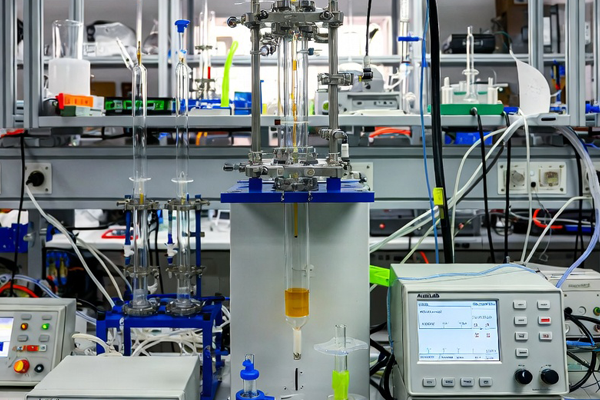
The Electrochemistry and Electrocatalysis Laboratory at the Department of Semiconductor Materials Engineering is dedicated to the investigation of electrochemical processes and catalytic reactions for energy and environmental applications. The laboratory focuses particularly on advanced nanomaterials, including two-dimensional (2D) materials, transition metal dichalcogenides (TMDs), MXenes, and related systems.
The laboratory is equipped with two high-precision AutoLab potentiostat/galvanostat systems enabling a wide range of electrochemical techniques, including:
- Cyclic Voltammetry (CV)
- Linear Sweep Voltammetry (LSV)
- Chronoamperometry (CA)
- Chronopotentiometry (CP)
- Electrochemical Impedance spectroscopy (EIS)
Measurements can be performed in both two- and three-electrode configurations, with precise control of current, potential, and scan rate parameters.
The laboratory infrastructure includes:
- Gas-tight electrochemical cells for controlled atmosphere experiments (N₂, Ar, H₂, O₂),
- Membrane-separated H-type cells for nitrogen reduction studies,
- Quartz cells for photoelectrochemical measurements,
The available equipment enables comprehensive electrocatalytic evaluation, including:
- Determination of overpotentials and Tafel slopes
- Electrochemically active surface area (ECSA) estimation,
- Faradaic efficiency calculations,
- Stability and long-term durability testing,
- Kinetic analysis using impedance spectroscopy
Additionally, electrochemical exfoliation of layered materials can be performed via the application of controlled high potentials to overcome interlayer van der Waals interactions, enabling the preparation of few-layer and exfoliated structures.
The laboratory supports research on sustainable electrocatalytic processes, including nitrogen reduction reaction (NRR), hydrogen evolution reaction (HER), nitrate reduction (NO3RR), and photoelectrocatalysis.
Contact
Prof. Robert Kudrawiec
E-mail: robert.kudrawiec@pwr.edu.pl
Tel. +48 713 204 280
Postal Address
Department of Semiconductor Materials Engineering
Wrocław University of Science and Technology
Wybrzeże Wyspiańskiego 27
50-370 Wrocław
Poland