Surface photovoltage (SPV) method
Laboratory
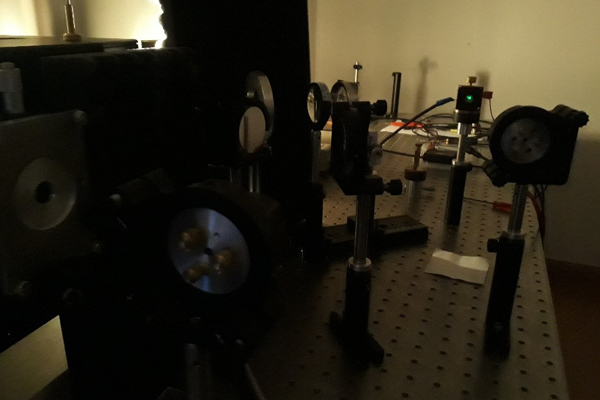
The surface photovoltage (SPV) method involves measuring the change in the electrical potential at the surface of a sample after illumination. Light generates charge carriers which, in the near-surface region, separate under the influence of the internal electric field associated with band bending. This leads to a change in the charge distribution near the surface and, consequently, to a change in the surface potential.
In this setup, the measurement is performed using a transparent electrode (e.g., a graphene electrode), which enables registration of the signal over a large area of the sample. The result of the measurement is an SPV spectrum; the appearance of a signal indicates the threshold for efficient photogeneration of charge carriers.
Contact
Prof. Robert Kudrawiec
E-mail: robert.kudrawiec@pwr.edu.pl
Tel. +48 713 204 280
Postal Address
Department of Semiconductor Materials Engineering
Wrocław University of Science and Technology
Wybrzeże Wyspiańskiego 27
50-370 Wrocław
Poland