The photoacoustic spectroscopy
Laboratory
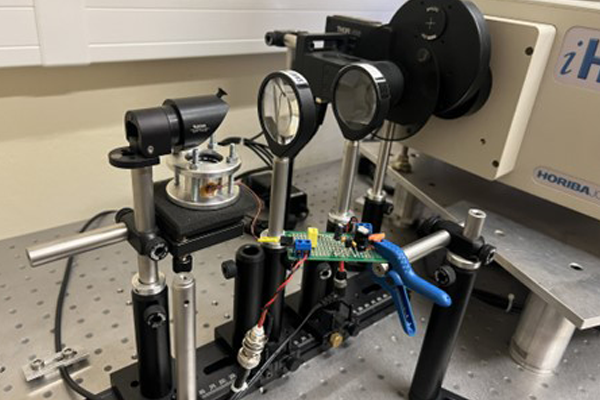
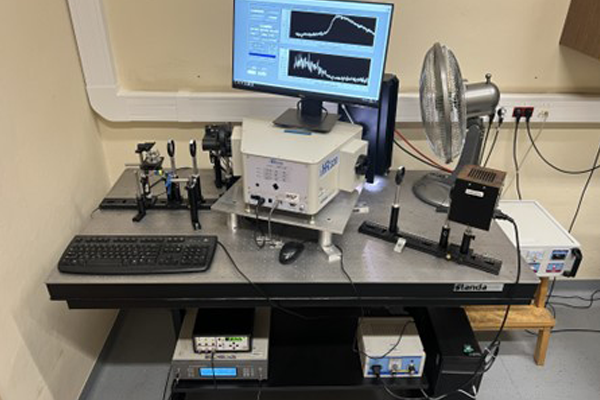
The photoacoustic spectroscopy (PAS) experimental setup at the Department of Semiconductor Materials Engineering is a powerful tool for investigating semiconductors and determining their optical properties, such as bandgap energies, excitonic features, and f-f and d-d electronic transitions and so on. The setup is equipped with a Xe arc lamp and a quartz–tungsten–halogen lamp, enabling measurements over a broad spectral range extending from the UV to the IR.
One of the key advantages of PAS is that no special sample preparation is required. Unlike many conventional spectroscopic techniques, which demand high-quality crystalline samples with well-prepared surfaces and specific geometries, PAS can be applied to a wide variety of materials without such constraints. Because the detected signal originates from acoustic waves generated by non-radiative relaxation processes, powders, drop-cast films, heterogeneous, opaque, highly scattering samples, as well as materials deposited on substrates, can all be investigated effectively using PAS.
Moreover, the sensitivity of PAS is largely independent of the spectral range. This contrasts with optical techniques such as transmission or reflection spectroscopy, where sensitivity varies due to the need for different photodetectors across different wavelength regions. As a result, a single sample can be measured over a very broad spectral range in PAS without changing the detector, while maintaining a consistent signal response.
Contact
Prof. Robert Kudrawiec
E-mail: robert.kudrawiec@pwr.edu.pl
Tel. +48 713 204 280
Postal Address
Department of Semiconductor Materials Engineering
Wrocław University of Science and Technology
Wybrzeże Wyspiańskiego 27
50-370 Wrocław
Poland